


Author Details:
Kaushik Sankar
AI Engineer
Pujitha Vasanth
Solutions Architect- AI
Date Published - 07-07-2026
Data & AI
On this blog:
Overview
"AI-first” is everywhere in boardrooms and standups, but most companies are nowhere near it. Using ChatGPT internally or adding a website chatbot is AI-adjacent, not AI-first. Being AI-first means embedding AI into how your business thinks, decides, and operates—not bolting it on afterwards. This guide, written for both founders and engineers, breaks down what that shift requires: the four pillars of an AI-first company (data as a first-class citizen, AI in the workflow rather than beside it, a model strategy instead of a single model, and a culture that iterates on AI), a practical Azure-based roadmap for getting started, and the common mistakes that derail AI transformation. The capability takes time to build—and the best time to start is now.
Introduction to AI-First

Data as a first-class citizen
AI in the workflow, not beside it
A model strategy, not just a model
A culture that iterates on AI
Key Highlights / Use Cases
Finance: invoice processing: Azure Document Intelligence extracts vendor, amount, line items, due date, and tax fields; Azure OpenAI matches the data against the purchase order and flags discrepancies; clean matches auto-approve and the analyst sees only exceptions. Processing time drops from 12–15 minutes to under 60 seconds per invoice over 100 manual hours saved each month at 500 invoices.
Customer support: RAG-powered agent assist: A Retrieval-Augmented Generation system on Azure OpenAI and Azure AI Search surfaces the most relevant docs and prior resolutions and drafts an accurate response in under three seconds. Agents review, adjust, and send. Response times typically drop 40–60 percent, and agents focus on complex, high-empathy cases.
Azure OpenAI Service: Access to GPT-4o, GPT-4, GPT-4o mini, and text-embedding-3-large within Microsoft Azure’s security and compliance boundary private endpoints, role-based access control, Azure Monitor integration, full audit logging, and provisioned throughput. The same /v1/chat/completions and /v1/embeddings API surface as OpenAI direct, behind your Azure AD and VNet stack.
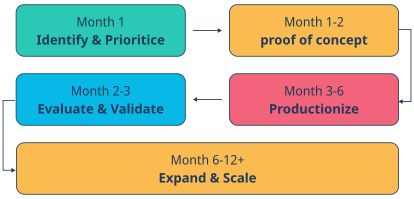
Practical roadmap milestone: companies that get their first AI workflow into production in month one are typically running five or six by month twelve not by scaling the team, but by building reusable foundations.

Conclusion
The companies with a durable advantage over the next decade are not the ones that adopted AI first as a headline announcement. They are the ones that built genuine institutional capability around AI: teams that know how to scope and build AI systems, data infrastructure that makes AI reliable rather than erratic, and workflows where AI makes every person measurably more effective.
That capability takes time to build. It cannot be fully outsourced or bought in a single contract—it requires internal learning, iteration, and consistent leadership commitment. The good news is that every company that commits gets better quickly, and the gap between those who have built this capability and those who have not will widen significantly over the next two to three years. The best time to start building that capability was two years ago. The second-best time is right now.
Ready to reduce cloud costs and improve efficiency? Let's innovate together.